

Do you feel like you're functioning but not truly alive? Dissociation in CPTSD refers to a disconnection from your thoughts, emotions, body, memories, sense of identity, or surroundings that can develop in response to prolonged or overwhelming trauma. This article explains why dissociation happens, how it affects everyday life, and provides practical coping strategies and evidence-based resources for healing common dissociative symptoms.
Reading time needed: approximately 4 mins.
Table of Contents
- What Is CPTSD, and How Is It Different from PTSD?
- Trauma Dissociation and the Window of Tolerance
- Six Common Dissociative Experiences and Ways to Cope
- Signs of CPTSD Recovery
- Healing Takes Time: Safety Comes First
- Questions and Answers for Dissociation and CPTSD

1. What Is CPTSD, and How Is It Different from PTSD?
Before exploring dissociation, it helps to understand what CPTSD means. Complex post-traumatic stress disorder (CPTSD) describes a pattern of psychological symptoms associated with repeated or prolonged traumatic stress. It often develops following long-term, difficult-to-escape interpersonal trauma, including childhood abuse. Alongside PTSD symptoms, CPTSD involves difficulties regulating emotions, a persistently negative sense of self, and difficulties feeling safe or connected in relationships.
PTSD often follows a major traumatic event, such as serious injury, a threat to life, sexual violence, or a disaster. A useful way to understand the distinction is that PTSD may follow a single overwhelming experience, whereas CPTSD is often associated with prolonged, repeated suffering. However, the diagnosis depends on the symptom pattern, not only on the number of traumatic events.
CPTSD includes additional difficulties known as disturbances in self-organization (DSO), involving three core areas:
- Emotion regulation: difficulty managing fear, tension, or distress and returning to a settled state.
- Negative self-concept: persistent feelings of worthlessness or failure, often accompanied by guilt, shame, or hopelessness.
- Relationship difficulties: difficulty establishing or maintaining closeness, with a tendency toward avoidance or disconnection.
In the ICD-11 framework, PTSD and CPTSD are related diagnoses and are not assigned together. CPTSD can involve substantial difficulties in daily functioning and may occur alongside depression, anxiety, or other mental health conditions.
People who experienced significant, ongoing relational trauma in childhood may be particularly vulnerable. Early relationships with caregivers shape how we experience trust, safety, and connection; insecure attachment patterns may continue into adult relationships.
If traumatic memories are accompanied by persistent emotional overwhelm, very low self-worth, or difficulty trusting others, these may resemble core CPTSD symptoms. A professional assessment can help clarify what you are experiencing. Difficulties in self-organization can also help us understand the broader context in which dissociation occurs.
2. Trauma Dissociation and the Window of Tolerance (The Core of Regulating Trauma Responses)
Emotional Dissociation, Numbness, and Disconnection
“Emotional dissociation” is often used to describe feelings becoming distant, numb, or difficult to access. You may know that something would normally make you sad, angry, or happy, yet feel nothing. You may also describe a painful experience clearly without feeling the emotions connected with it.
Emotional numbness may be related to trauma-associated dissociation, but it can also occur with depression, prolonged stress, burnout, or other psychological states. Numbness alone does not establish a diagnosis of CPTSD or a dissociative disorder.
If you often feel as though you are watching life from the outside, or struggle to identify your emotions, notice when this happens, how long it lasts, and whether it affects work, relationships, or everyday life. Gradually rebuilding body awareness and recognizing emotions in a safe environment can be part of reconnecting with yourself.
Dissociation involves a sense of disconnection between emotions, bodily experience, memory, sense of self, or surroundings. You might function at work or care for your family while feeling on autopilot, emotionally numb, or detached from your body. For people with complex trauma, dissociation may be a way of coping with overwhelming stress. It is not a required symptom of CPTSD, and not everyone who experiences dissociation has CPTSD.
What is Trauma Dissociation in CPTSD?
When facing traumatic experiences, many people experience a feeling of “leaving reality”, as if they are not inside their body, and the world becomes blurred and unreal. This state is called trauma dissociation. It can look very different from person to person. Some people feel emotionally numb or “far away” from themselves. Others continue working, socializing, and completing daily tasks while feeling internally disconnected. Some people experience a sudden shutdown after a trigger, while others live with a more persistent sense of being detached or “not fully here.”
Dissociation is not always obvious from the outside. A person can appear calm, productive, or even cheerful while experiencing significant internal disconnection.
Dissociation is not a “problem” in itself; it is a way that once protected you. However, when it occurs frequently, we need to learn new stabilization techniques and grounding exercises to help ourselves return to the present moment.
What is Window of Tolerance?
The starting point for all of this is understanding a key concept: the Window of Tolerance. The Window of Tolerance refers to the optimal zone in which a person can maintain emotional stability and good physical and mental regulation. When you are within your window, you typically:
-
Feel relatively safe and stable
-
Are able to focus on tasks
-
Can listen and express yourself
-
Stay connected with yourself and others
But when you go beyond this window, you enter two different states, as shown in the figure below:
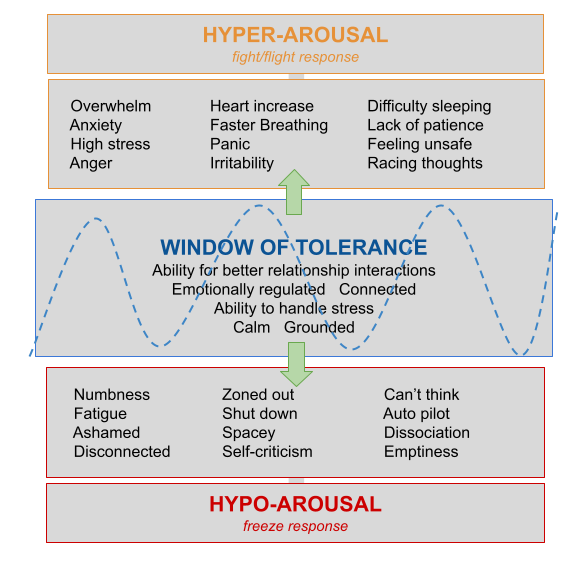
Hyper-Arousal (exceeding the upper limit, overactivated, fight/flight):
Manifests as rapid heartbeat, tension, hypervigilance; racing thoughts that won’t stop; anxiety, panic, irritability.
Hypo-Arousal (falling below the lower limit, under-activated, freeze/dissociation):
Manifests as emotional numbness, emptiness; feeling “unreal” or “detached from the body”; lack of motivation, depression, exhaustion; slowed or difficulty thinking.
Trauma dissociation often occurs when one falls below the window of tolerance.
3. Understanding Six Common Dissociative Experiences in CPTSD and Ways to Cope
Single-incident PTSD can also cause dissociation, but there are key differences in how it manifests compared to dissociation caused by CPTSD:
-
Dissociation in PTSD is typically situationally triggered. It is often linked to a specific traumatic event (such as an accident, violence, or disaster). When an individual encounters similar cues (sounds, images, smells, etc.), they may experience a brief “leaving the present” episode, such as flashbacks, distorted time perception, or temporary feelings of unreality. This type of dissociation is more like the brain “replaying” unprocessed traumatic memories.
-
Dissociation in CPTSD is more often a chronic, pervasive state. Due to long-term, repeated interpersonal trauma (such as childhood neglect or relational trauma), an individual may develop more stable dissociative patterns, including persistent emotional numbness, a blurred sense of identity, or a feeling of detachment from oneself or others. This form of dissociation does not necessarily require a clear trigger; instead, it functions more as a “long-term offline” survival strategy. Such chronic, pervasive dissociation may, in some cases, progress to DID.
Simply put, PTSD dissociation is more like a “triggered, temporary disconnection,” while CPTSD dissociation is more like a “chronically low-connected state formed through long-term adaptation.” Below are six typical characteristics of CPTSD dissociation:
-
Outwardly Functional, Inwardly "Gone"
You might seem calm and productive, but often zone out or feel stuck. That’s dissociation, a very real feeling of "leaving your body."
🧩 Try this: Ground yourself in the present. Feel your feet on the floor, smell something nearby, or hold ice. Gently "come back to yourself." -
Small Triggers, Big "Shutdowns"
A tone of voice or a memory can suddenly make you feel numb or blank. These "small" things aren’t small, they tap into deep, long-held pain. Dissociation is your body’s way of protecting you when you’re overwhelmed.
🧩 Try this: In safe moments, notice when "a part of me feels gone." Learn what usually triggers you.
-
"Shut Down" Doesn’t Mean You Stop
You might still finish tasks quickly or smile brightly around others. This is "high-functioning dissociation": outwardly okay, inwardly switched off. The danger? You might not notice until you next crash.
🧩 Try this: Pause briefly each day. Take 1 minute to check in with your breath and how you really feel inside.
-
Only "Alive" When Safe
You feel real, present, and safe only with trusted people or in comforting places. Afterward, you might "shut down" again.
🧩 Try this: Create safe spaces, soft light, quiet, no interruptions. Remember past safe moments or people to anchor you.
-
Watching Life Like a Movie, Feeling Like a "Ghost"
You feel like an outsider watching yourself live, seeing yourself laugh or cry, but it doesn’t feel real. Like there’s a foggy wall between you and the world.
🧩 Try this: Practice feeling your body: notice your chest, belly, breath, or heartbeat. Slowly come back "home" to yourself.
-
Dissociation: Your Past Ally, Your Present Challenge
Dissociation helped you survive in the past. Now, it may block your emotions and connections.
🧩 Try this: Journal: "Right now I feel… Where am I?" Talk softly to yourself, it helps you return. To learn more about the parts that once used dissociation to protect you, explore how IFS helps understand and work with dissociation.
- Here is a more thourough guidance for grounding techniques:
grounding exercises for reconnecting during CPTSD dissociation
4. Signs of CPTSD Recovery: How Can You Tell You Are Gradually Improving?
Recovery from CPTSD is usually not a straight upward path. Improvement does not necessarily mean anxiety, emotional fluctuations, or dissociation never happen again. It may mean having more choices, noticing your state earlier, and responding to stress with greater flexibility.
Possible signs of recovery include:
- Recognizing triggers earlier: noticing which situations, tones of voice, or relationship interactions bring numbness, fear, or disconnection.
- Gradually recognizing emotions: beginning to identify sadness, anger, fear, or a need for support instead of feeling only blank.
- Returning to the present more easily: using grounding practices, environmental cues, or contact with a safe person to regain a sense of being here and now.
- Less self-blame: understanding that some responses once helped you cope, rather than seeing them simply as weakness or failure.
- More choices in relationships: expressing boundaries, seeking support, or giving yourself space when you feel unsafe.
- Greater capacity for complex feelings: being able to experience and work with sadness or anger without immediately suppressing or escaping them.
These signs are not formal diagnostic criteria and do not necessarily appear in a fixed order. Setbacks can still happen; feeling numb or dissociated on one day does not erase earlier progress. If dissociation is frequent, affects everyday functioning, or involves significant memory gaps, seek assessment and support from a mental health professional with relevant experience.
5. Healing Takes Time: Safety Comes First
Pushing too fast in CPTSD healing can make your body "check out." If you rush into deep work (like EMDR) without enough safe relationships and emotion regulation skills, you might dissociate more, or feel like therapy isn’t working.
🧩 Follow the 3-stage trauma approach:
-
Safety & Stability
-
Processing Memories & Feelings
-
Rebuilding Your Story & Self
Dissociation was the best way you knew to protect yourself. Now, in safety, it’s just a habit that no longer fits most situations. Healing starts when you learn why and when you dissociate. Remember: Slow is Fast.
If you are exploring treatment options, you can compare IFS, EMDR, and Sensorimotor Psychotherapy and how they may be integrated.
For a broader overview, read our comprehensive CPTSD treatment guide, from bodily experience to relationship repair, with a reading list.
If dissociation repeatedly affects everyday life, you can also learn about trauma-informed individual therapy and consider whether professional support would help.
Simple Daily Practice
-
Wake yourself up once a day: Feel your feet on the ground. Smell something nearby. Gently come back to your body.
-
When you feel that "dead-then-alive" shift, don’t fear it. See it as a reminder:
You’re worthy of being seen.
And dissociation? It’s just your oldest protector trying to care for you.
You’re not broken, you’re adapting. And adaptation can gently change.
6. Questions and Answers for Dissociation and CPTSD
Question 1: What is the “Window of Tolerance” in CPTSD dissociation? Why is it important for understanding dissociation?
Answer: The Window of Tolerance was first proposed by Siegel (1999) and later systematically elaborated by Ogden, Minton, and Pain (2006) in somatic psychotherapy. It refers to the optimal zone of arousal in which a person can maintain emotional stability and regulate their body‑mind well. When an individual is within the window, they feel relatively safe and stable, can focus, listen and express themselves, and stay connected with themselves and others. When they go above the upper limit (hyperarousal), they experience anxiety, panic, and irritability. When they fall below the lower limit (hypoarousal), they enter a freeze or dissociative state. Dissociation in CPTSD typically occurs below the Window of Tolerance. Understanding this concept helps individuals recognize when they are entering dissociation and use grounding exercises to return to the window. [2][5]
Question 2: What is the key difference between dissociation in CPTSD and dissociation in PTSD?
Answer: Dissociation in PTSD is usually situation‑triggered. It is often linked to a specific traumatic event (such as an accident, violence, or disaster). When the individual encounters similar cues (sounds, images, smells, etc.), they may experience a brief “leaving the present moment” episode, such as flashbacks, distorted time perception, or a short‑lived feeling of unreality. It is more like the brain “replaying” unprocessed trauma memories. In contrast, dissociation in CPTSD is more often a chronic, diffuse state. Due to long‑term, repeated interpersonal trauma (such as childhood neglect or relational trauma), individuals may develop more stable dissociative patterns, such as persistent emotional numbness, blurred sense of identity, or a feeling of estrangement from oneself or others. This dissociation does not necessarily need a clear trigger; it functions more like a “long‑term offline” survival mode. Leaf Light Therapy suggests that PTSD dissociation is more like “triggered, brief disconnection,” whereas CPTSD dissociation is more like “a chronically adapted low‑connection state.” [1][3]
Question 3: What is “high‑functioning dissociation”? Why is it particularly easy to overlook?
Answer: High‑functioning dissociation refers to a state in which a person appears completely normal on the outside, emotionally stable, highly productive, even smiling and engaging socially, while internally they have already “shut down” or gone numb. Leaf Light Therapy points out that this is the third of the six typical features of CPTSD dissociation. The most dangerous aspect is that because the outer appearance is so normal, even the individual themselves may not notice anything wrong, until one day they suddenly and completely break down. The article suggests taking short, regular pauses each day, stopping for one minute to check in with your body and breath, and examining your internal state. [3][9]
Question 4: Why do CPTSD patients only feel “alive” again when they are in a “safe” situation? How can this be addressed?
Answer: This phenomenon stems from a post‑traumatic self‑protection mechanism, only in a sufficiently safe environment does the nervous system dare to “relax its guard” and allow the authentic self to emerge. This is the fourth of the six typical features: patients may find that they only feel real, safe, and present when in a particularly comfortable environment or with a particularly trusted person. Once they leave that place or that person, they return to that “walking dead” dissociative state. Leaf Light Therapy suggests consciously creating a safe space for yourself (soft lighting, quiet, no interruptions), and also imagining past safe times and places, or a “safe other” as an anchor. [2][9]
Question 5: What is interoception? What role does it play in healing dissociation?
Answer: Interoception is the ability to sense and understand signals coming from inside the body, including sensing the chest, abdomen, breath, heartbeat, etc. Research shows that body dissociation is an important mediating factor linking childhood traumatic experiences to current emotional dysregulation, and improving interoceptive ability can help individuals re‑establish connection with their body. Leaf Light Therapy suggests practicing interoception (feeling the chest, belly, breath, heartbeat) to slowly allow yourself to “re‑enter your body,” thereby alleviating the sense of alienation caused by dissociation. [6][10]
Question 6: Why should CPTSD patients not rush into deep trauma processing (such as EMDR)?
Answer: If one rushes into deep healing without first building sufficient stabilization skills and a safe therapeutic relationship, the body will “automatically shut down,” leading to worse dissociation, and even therapy may feel completely ineffective. This is because the nervous system of a CPTSD patient may not yet have enough capacity to hold the impact of traumatic memories. Leaf Light Therapy recommends a three‑phase trauma treatment approach: Phase 1, Safety and Stabilization (building grounding skills and the Window of Tolerance); Phase 2, Processing memories and feelings; Phase 3, Integration of self and new narrative. Slow is fast, stabilizing the first step is the only way to truly enter deep healing. [2][9]
Question 7: Why is dissociation in CPTSD described as “functioning on the surface while disappearing inside”? How to cope with it?
Answer: This is the first of the six typical features of CPTSD dissociation listed by Leaf Light Therapy. The person may appear emotionally stable, highly functional, and business‑as‑usual, but often “zones out” or “gets stuck,” as if their soul has “floated away” from their body, that is dissociation at work. Coping methods include “grounding exercises”: firmly feel the solidity of your feet on the ground, smell something strong (orange peel, essential oil, perfume, etc.), or hold an ice cube for a while, use concrete sensations to pull yourself back and “return” to your body. [3][8]
Question 8: What is the “Structural Dissociation of the Personality” theory? How does it explain dissociation in CPTSD?
Answer: The Structural Dissociation theory was proposed by van der Hart, Nijenhuis, and Steele (2006). It holds that dissociation is not a single phenomenon, but a psychobiological “split” in the personality. In complex trauma, the personality is divided into different parts: an “Apparently Normal Part” (ANP) that manages daily functioning, and one or more “Emotional Parts” (EP) that are stuck in traumatic action patterns. Leaf Light Therapy summarizes this phenomenon as “watching others like watching a movie, feeling like a ghost oneself” and “living like a bystander”, these are typical manifestations of structural dissociation. The therapeutic goal is to gradually integrate these split parts and improve overall integration. [3][4]
Question 9: Why is dissociation said to be “a past companion but a present obstacle”?
Answer: Leaf Light Therapy points out that dissociation was once the “most powerful skill” a patient found in their most helpless times, it was precisely through dissociation that the patient survived an inescapable traumatic environment, and this protective function should not be negated. However, once the individual has entered a relatively safe environment, this former protective mechanism becomes an obstacle to adapting to life: it blocks emotions and connection, hindering authentic relationships and self‑experience. This is the deeper meaning of why Leaf Light Therapy emphasizes that “dissociation is a past companion but a present obstacle”: there is no need to feel shame or fear about dissociation; instead, understand that it was once a protector, and on that basis, learn new coping methods that are more suitable for the present. Journaling, “speaking gently to yourself,” and similar methods are important ways to return to reality and care for yourself after dissociation. [11][10]
About Author:
Li Li, Registered Psychotherapist in Ontario, integrating psychoanalytic psychotherapy and trauma-informed modalities such as EMDR, Sensorimotor, IFS, EFT, for relationship issues and complex PTSD trauma therapy.
Book a free consultation with me to start your healing journey today.
References
[1] Stubley, J., Chipp, B., & Buszewicz, M. (2025). Diagnosis and management of complex post‑traumatic stress disorder (C‑PTSD). BMJ, 388, e079458. https://pubmed.ncbi.nlm.nih.gov/39884700/
[2] Ford, J. D., & Courtois, C. A. (Eds.). (2021). Treating complex traumatic stress disorders in adults: Scientific foundations and therapeutic models (2nd ed.). Guilford Press. https://www.guilford.com/books/Treating-Complex-Traumatic-Stress-Disorders-in-Adults/Ford-Courtois/9781462543625?srsltid=AU7gw4Xuuuy2OdXA9Rh00JInzpDp6Xvqzlyfc-bZyJQKNPJRTD63XkMC
[3] van der Hart, O., Nijenhuis, E. R. S., & Steele, K. (2006). The haunted self: Structural dissociation and the treatment of chronic traumatization. W. W. Norton & Company. https://www.researchgate.net/publication/46681133_The_Haunted_Self_Structural_Dissociation_and_the_Treatment_of_Chronic_Traumatization
[4] Van der Hart, O., Nijenhuis, E., Steele, K., & Brown, D. (2004). Trauma‑related dissociation: Conceptual clarity lost and found. Australian & New Zealand Journal of Psychiatry, 38(11‑12), 906–914. https://pubmed.ncbi.nlm.nih.gov/15555024/
[5] Lanius, R. A. (2015). Trauma‑related dissociation and altered states of consciousness: A call for clinical, treatment, and neuroscience research. European Journal of Psychotraumatology, 6, 27905. https://doi.org/10.3402/ejpt.v6.27905
[6] Schmitz, M., Back, S. N., Seitz, K. I., Harbrecht, N. K., Streckert, L., Schulz, A., Herpertz, S. C., & Bertsch, K. (2023). The impact of traumatic childhood experiences on interoception: Disregarding one‘s own body. Borderline Personality Disorder and Emotion Dysregulation, 10, 5. https://pmc.ncbi.nlm.nih.gov/articles/PMC4439425/
[7] van der Hart, O., Groenendijk, M., Gonzalez, A., Mosquera, D., & Solomon, R. (2013). Dissociation of the personality and EMDR therapy in complex trauma‑related disorders: Applications in the stabilization phase. Journal of EMDR Practice and Research, 7(2), 81–94. https://spj.science.org/doi/10.1891/1933-3196.7.2.81
[8] Hammond, J., & Brown, W. J. (2025). Building an operational definition of grounding. Trauma, Violence, & Abuse, 26(3), 1–13. https://journals.sagepub.com/doi/10.1177/15248380251343189
[9] Li Li (2026), Leaf Light Therapy, Toronto Trauma Therapy, Healing CPTSD Modalities Comparison & Integration: IFS vs EMDR Therapy vs Sensorimotor Psychotherapy
[10] Fisher, J. (2017). Healing the fragmented selves of trauma survivors: Overcoming internal self‑alienation. Routledge. https://www.routledge.com/Healing-the-Fragmented-Selves-of-Trauma-Survivors-Overcoming-Internal-Self-Alienation/Fisher/p/book/9780415708234
[11] Lanius, U. F., Paulsen, S. L., & Corrigan, F. M. (Eds.). (2015). Neurobiology and treatment of traumatic dissociation: Toward an embodied self. Springer Publishing Company. https://www.springerpub.com/neurobiology-and-treatment-of-traumatic-dissociation-9780826106315.html?srsltid=AU7gw4WbGfbH82s-YsNV0kixa6DUgLLfHk6v_JHn3CfzEJQNKkDw99xm